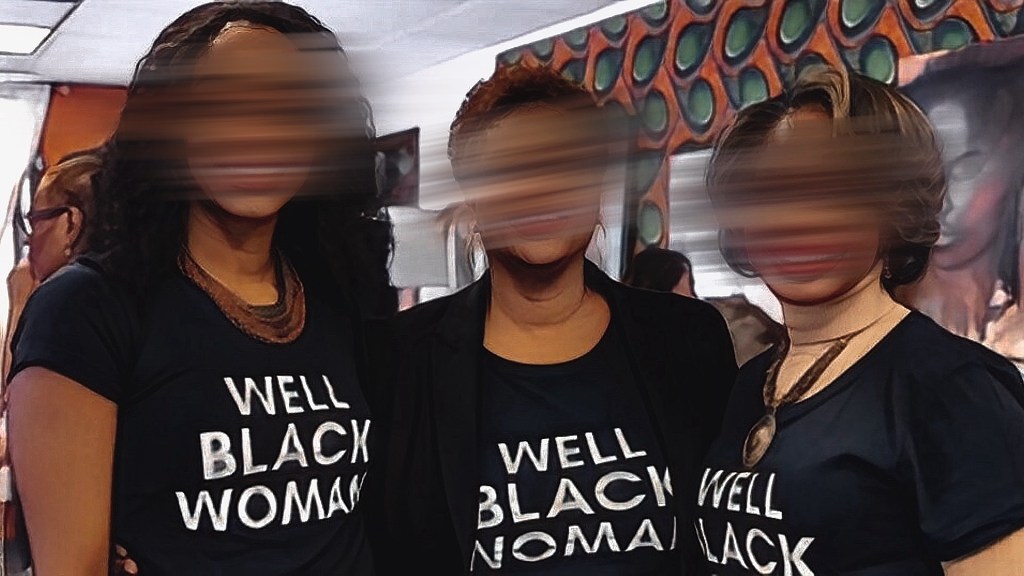
What happens when the work meant to create safer spaces for people who look like you is also the work that is slowly destroying your mental health? This is a question that I and so many other Black women who do equity, diversity, and inclusion work have had to ask ourselves. It is the constant battle between wanting to keep up the fight but also trying not to burn yourself out until there’s no more fight left.
I started doing equity work over ten years ago. I wouldn’t have called it that back then. To me, I was just trying my best to push back against spaces that made it exceptionally hard for me to exist in. Often, when I facilitate, I say to participants that “many of us become activists at such an early age.” When you’re Black, Indigenous, or racialized, or when you’re queer or living with a disability, you are often forced at a young age to advocate for yourself. I will never forget walking into kindergarten on my first day of class and being told by another kid that I couldn’t play with the toys because I was brown. I remember my heart being broken when, after a friend saw us together and commented, “Why are you hanging out with that Black girl?” my best friend at eight told me she couldn’t be my friend anymore. The constant bullying and violence I faced as a small child meant I was constantly having to defend myself from a system I didn’t yet understand. There are numerous other examples I could give that took place throughout my childhood and teen years, but regardless, it was no surprise to anyone, or even myself, that I would end up doing EDI work as I became an adult.
When I first began running for equity positions in universities and working at nonprofits, I had this fire inside me. I was ready to make real change and to work to create a safer space for my community and those around me. I wrote for my school newspaper and had a radio show with some friends. I organized protests and even led one into my university president’s office. From 2013 to 2018, I did everything I could to try and leave my school and the city of Peterborough a better place than how I met it. Throughout this time is when I met other Black women and femmes who were also passionate about social justice and equity work. They were powerhouses who refused to be silenced no matter the threat of violence or the systems that tried to stop them. I watched as so many of them put their lives on the line to fight for Black people and the Black community, even when other Black people didn’t always love them for it, particularly Black men. As we shifted from being university and college students to employees in the workforce, many of us found our way to nonprofits. Not wanting to work in corporate Canada, stuck in colonial structures filled with rich, able-bodied, straight white men, we gravitated to organizations that more closely aligned with our beliefs and morals. During the aftermath of Trayvon Martin, Mike Brown, Andrew Loku, Jermaine Carby, Colten Boushie, and Tina Fontaine, organizations were looking to do more equity work around Black and Indigenous peoples. The Idle No More and Black Lives Matter movements also forced many Canadians to at least acknowledge that there was a problem.
Now, I strongly believe in the “for us, by us” mantra when it comes to how we create safer spaces for Black folks and any marginalized community. The problem is that equity work cannot rest solely on the shoulders of those communities and, even more so, on the shoulders of Black women. What I quickly started to realize is that I and other Black women were being looked to do the majority of the work, if not the entirety of it, with barely a fraction of the recognition or support. What made this even worse was that this work was expected to be done under the same tired stereotypes, policing, and systemic oppression that has always existed, even within organizations that claimed to work within opposing frameworks. They hired us because they loved how “passionate” we were and how we were vocal about calling out systems of oppression like policing or systemic discrimination. Our community ties and reputation were seen as assets that would allow them to help the people who truly needed it. That love quickly turned to irritation and disapproval when that call for accountability turned inward. When our passion focused on the structures within these organizations that weren’t actually beneficial, when the systems we wanted to call out, like the government, were the ones funding them, and when the systems of discrimination were being replicated internally.
I watched as colleagues who were also supposedly committed to equity turned around and began using common anti-Black tropes. Soon, I and the Black women around me were being referred to as aggressive, disrespectful, and their ol’ reliable, angry. We were being tone-policed, micromanaged, and surveilled. While our non-Black staff were given verbal warnings for “inappropriate behavior,” we were being written up, put on forced leaves, or fired altogether. New policies were being created just for us to address the ways in which we wrongfully applied our learnings to the environments we were working in. 2020 brought what seemed like a glimmer of hope that quickly turned into Black squares and fake solidarity actions in the name of addressing anti-Black racism. I watched as organizations that had caused immense harm to Black women turned around and claimed to be standing firmly in allyship with Black people. They shared strategic plans to address anti-Black racism and paraded their remaining Black staff around as a show and tell to prove just how much they care about Black people. All of a sudden, they wanted to create spaces for Black people and programs that spoke to Black experiences. Organizations that neither had a single Black staff member nor had never worked with the Black community before were now looking to diversify their staff and services. And the majority of the people they were hiring were Black women and femmes. I have never been more booked and busy than I was from 2020 to 2021. The issue with flooding spaces with Black women when there previously weren’t any Black people is that those spaces haven’t done the work to actually be as safe as they possibly can. So with that came the previously mentioned anti-Black micro and macro aggressions.
Since the murder of George Floyd and the shift (though superficial) in the Canadian consciousness, I have watched as the Black women around me have been overworked, underpaid, underappreciated, overpoliced, and oversurveilled by the very organizations that claim to be working to create a safer world for them to exist in. We are all exhausted. Code-switching is one thing, but the way in which these organizations have asked us to make ourselves small is another. We’re asked to create equitable policies and protocols but not to push too hard, not to speak too directly or bluntly, and to make sure our tones are “soft” or “approachable.” We are asked to take disrespect and misplaced anger graciously and with a smile on our faces; otherwise, we’re painted as being difficult or overreacting. Let me also not forget the moments when non-Black staff push back against the equity direction an organization is going in, and it is us who are forced to explain why it is important for us to have policies in place that recognize our humanity. Black women are tired. We are continuously asked to carry the weight of changing the world for everyone on our shoulders. And the farther away a Black woman is from a proximity to whiteness, the heavier that weight is. Darker-skinned, fat, disabled, and Queer Black women are subjected to the most egregious acts of anti-Blackness in these spaces, even at times at the hands of other Black people.
I say all this to point out that equity work cannot be done without Black women, and Black women can no longer work under the conditions you continue to put us under. We are no longer willing to be on the front lines of social change just to be left open to be slaughtered. And even if we were willing, we no longer have the energy to do so. Every single Black woman I know who does this work is on the brink of a mental breakdown, pushed to tears daily, and unable to take a break for fear of losing their livelihood. Organizations need to do better. Non-Black, non-Black women need to do better. Either ensure the spaces you want to work in are as safe as humanly possible or don’t ask us to risk our health to make them better for you to exist in while we suffer.
I also say all of this to tell Black women that I see you. I see the pain you are in, I see how you slump your shoulders from the near exhaustion of it all, and I see how you are barely holding yourselves up. I say this to tell you that you are deserving of rest, and that despite what the world is constantly telling you, you do not need to carry the weight of it. While the world can’t afford for us to opt out of this fight, we can’t afford to kill ourselves for a battle no one else wishes to take up arms in. Step back, rest, disconnect, and prioritize your mental health. You matter even more than the world says you do, and if no one has said it to you yet today, I love you.
 Nutmeg and Sage